Bag Sealers for Home Use: What Can You Use One For?
A bag sealer probably isn’t something you’ve ever thought you needed.
In fact, if someone had told me a few years ago that I’d find a machine for sealing plastic bags genuinely useful around the house, I’m not sure I would have believed them.
But there are those little household jobs where you find yourself thinking, there must be a better way of doing this.
A packet that’s been opened and won’t stay closed.
Small bits and pieces that need keeping together.
Craft supplies that have somehow escaped their packaging.
Something you’ve made yourself that you’d like to put into a neat, properly closed bag.
This is where a small heat sealer can be surprisingly handy.
It’s not an essential household appliance, and nobody is suggesting you need one next to the toaster. But if you have the sort of hobbies, projects or storage jobs that involve bags, it can be a very useful little tool.
So, what does a bag sealer actually do?
The basic idea is very simple.
A heat sealer uses heat and pressure to join suitable plastic film together. With an impulse sealer, the heating element heats for a short period while the sealing arm is pressed down. The heat softens the appropriate material, the layers are pressed together and the seal is formed as it cools.
There isn’t much to it.
You put the open edge of the bag into the sealer, press the arm down, wait for the sealing cycle to finish and release it.
Once you’ve done a few, it becomes one of those jobs you don’t really think about.
And there’s something rather satisfying about getting a perfectly straight seal.
What can you use one for at home?
More than you might expect.
You don’t have to run a business or pack hundreds of parcels to make use of a bag sealer.
At home, they can be useful for things such as:
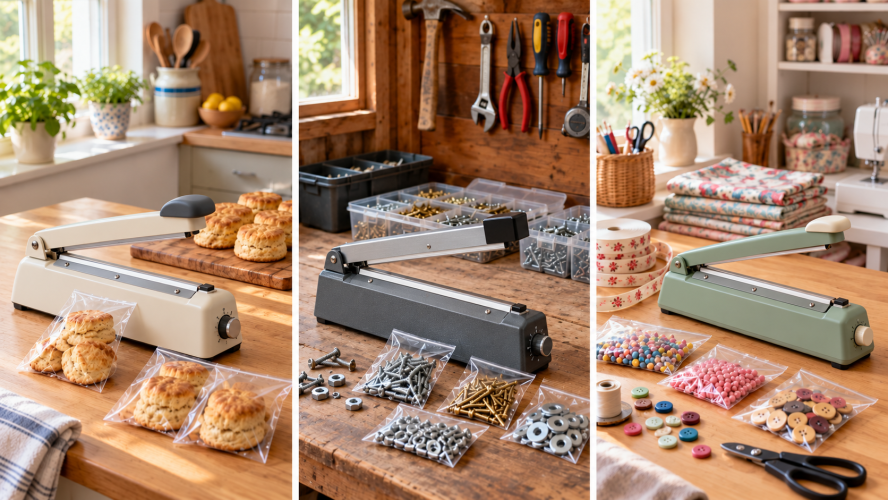
Craft and hobby materials
Beads, buttons and sewing supplies
Small screws, nuts, bolts and fittings
Handmade gifts
Items you’re storing for later
Small collections of parts that you don’t want loose in a drawer
Packaging things you’ve made yourself
Sealing suitable bags after they’ve been filled
Making simple bags from suitable layflat tubing
And if you have children who enjoy crafts, you may discover another use for it: keeping all those tiny things that seem to migrate around the house in one place.
The humble bead is remarkably good at escaping.
Why not just use tape?
You can.
For the occasional bag, tape is perfectly adequate. There is no need to buy a machine simply because you have one packet to close.
Where a sealer starts to earn its keep is when you’re doing the same thing repeatedly.
If you’re regularly packing items into bags, a heat sealer gives you a quick and consistent way of closing them. You don’t have to cut another piece of tape, find the end of the tape roll or discover that the tape has somehow stuck to itself before you’ve even reached the bag.
The finished seal is also neat and unobtrusive.
For some people, that’s the main attraction.
It’s useful for organising things too
This is probably one of the less obvious benefits of having a sealer at home.
Small bags are brilliant for organising things, but an open bag isn’t always much use when its contents can spill out into a drawer.
You can put similar items together, seal the bag and add a label.
Think:
“Picture hooks — small.”
“Spare sewing machine feet.”
“M6 washers.”
“Christmas ribbon — silver.”
You may not think you’ll need to label them.
You will.
Especially six months later.
A sealed bag also means you can move things around without everything falling out, which is particularly useful when you’re storing lots of small items.
What about food?
A bag sealer can be useful for food packaging, provided you’re using bags or film that are specifically suitable for food contact and heat sealing.
It’s worth checking the packaging material before you start, as not every plastic bag is designed to be heat sealed. Different materials can also need different sealing times and temperatures.
If you’re using a new type of bag or film, it’s a good idea to try a seal on an empty bag first. A quick test will tell you whether the setting is right and whether the finished seal looks and feels secure.
For food, it’s especially important to use packaging intended for the job and to follow any guidance supplied with the bags and sealer.
That little bit of preparation can save a lot of wasted packaging later.
What sort of bags can you seal?
This is an important point, because plastic is not just plastic.
Impulse heat sealers are commonly designed for heat sealable films such as polyethylene (PE) and polypropylene (PP), although the exact materials a particular machine can handle will depend on the model.
The thickness of the material matters too.
That’s why many sealers have an adjustable timer or heat setting. Thicker film can require a different sealing time from thinner film.
So before buying a sealer, it’s worth checking the material you’re actually planning to use.
It saves a lot of guesswork later.
Getting the setting right
This sounds more complicated than it is.
If your sealer has an adjustable heat or time control, start with the manufacturer’s recommended setting and make a test seal.
You’re looking for a clean, even seal.
If the two layers haven’t joined properly, it may need a little more heat or sealing time. If the material is excessively melted or damaged, you’ve probably gone too far.
The good news is that once you’ve found the setting that works for your particular bags, you can usually stick with it.
And testing one empty bag first is considerably better than filling 30 bags and finding out afterwards that the setting wasn’t quite right.
Do you need a big machine?
For home use, probably not.
There’s no great prize for owning the largest heat sealer you can fit on the kitchen table.
The important thing is to choose a machine that suits the bags you’re actually going to use.
One of the main specifications to look at is sealing width.
If your bags are 200mm wide, for example, you need a machine with enough sealing width to accommodate the opening. Heat sealers are available in a range of widths, including smaller tabletop models and much larger machines designed for higher volume work.
For occasional jobs around the house, a compact tabletop model is likely to be much more practical than a machine intended for a busy packing operation.
What about a sealer with a cutter?
Some heat sealers come with an integrated cutter.
It’s not something everyone needs, but it can be useful if you’re working with layflat tubing or want to trim away excess material after making a seal.
The basic idea is quite clever.
You can seal one end of the tubing, cut it to the length you need, put your item inside and seal the other end. That allows you to make bags to your own required length rather than relying entirely on ready made bags.
For someone who does a lot of craft work or makes things at home, that can be rather useful.
For someone who just wants to close the occasional bag, it’s probably not something you need to worry about.
Is a heat sealer difficult to use?
Not really.
That is one of the reasons I like them.
There’s no complicated setup and no lengthy learning curve. Once you’ve got the right material and a suitable setting, the process is very straightforward.
The only thing worth taking a little care with is positioning the bag.
Keep the opening reasonably flat and make sure the area you’re sealing is clean. You want the two layers of film sitting properly together rather than trying to seal through folds, bits of product or crumbs.
A tidy seal starts with a tidy bag opening.
A few things worth checking before buying one
If you’re thinking about getting a bag sealer for home use, I’d look at these things first:
1. What material will you be sealing?
Check the bags or film you already use. Make sure the sealer is suitable for them.
2. How wide are your bags?
Check the sealing width of the machine against the width of your bags.
3. How thick is the material?
A thicker bag may need a different setting from a thin film bag.
4. How often will you use it?
If it’s going to come out of the cupboard once every six months, there’s little reason to buy a heavy duty machine.
If you’re constantly packaging craft items, handmade products or other things, spending a little more on a suitable machine may make sense.
5. Do you actually need a cutter?
If you’re using ready made bags, perhaps not.
If you want to make bags from layflat tubing, it could be useful.
These are fairly simple questions, but answering them before you buy is much better than choosing a machine based purely on how impressive it looks in the photograph.
Where can you find bag sealers?
If you’re looking for a sealer for home use, you can have a look at the Bag sealers available from Discount Self Seal Bags.
Have a look at the specifications of each machine and, most importantly, make sure it suits the bags or film you intend to use.
The right sealer isn’t necessarily the biggest or most powerful one.
It’s the one that does the job you actually have in mind.
So, do you really need one?
Probably not.
And that’s okay.
A bag sealer isn’t an essential bit of kit for every home.
But if you regularly work with small bags, enjoy crafts, make things at home, sell handmade products, organise lots of small components or simply like finding sensible ways to keep things tidy, it can be one of those surprisingly useful tools.
It’s also a nice example of a piece of equipment that does exactly what it says on the tin.
Or, in this case, the bag.
Once you’ve got the right bags, the right setting and a little practice, you press the arm down, wait a moment and you’ve got a neat sealed edge.
No wrestling with tape.
No tying knots.
No searching the drawer for that little plastic clip you were absolutely certain you’d put somewhere sensible.
Just a sealed bag.
And sometimes, that’s all you need.